
After commodities spiked in the wake of Russia’s invasion of Ukraine, most have dropped as most Russian exports have been redirected towards less hostile countries. A stark exception has been natural gas, where the market has been upended by a sharp drop of Russian pipeline gas shipments into Europe.
The scramble to replace Russian gas in Europe with liquified natural gas (LNG) imports from the US, Qatar and Australia has sent gas benchmark prices soaring.
Securing LNG supply is not an easy task as the majority of LNG is sold on long-term contracts. In 2021, just 37% (which was a record) of LNG cargoes were sold on an uncontracted basis. Europe’s need to refill gas storage levels ahead of the winter has put it in direct competition with other spot buyers in the market.
The situation has been made worse by disruptions to other power sources on the continent. For the first time since 2012, when French records began, the country has become a net importer of power as its own production of nuclear production hit a 30 year low. A record number of the country’s 56 nuclear reactors have gone offline for overdue maintenance and checks related to corrosion issues that became apparent last December. The heatwave across Europe is also having an impact. River water used to cool the nuclear plants is too warm to cool the reactors and be safely discharged back into the rivers without causing environmental damage to the wildlife ecosystem. This has forced facilities that weren’t under maintenance to curtail production. In a normal year, France exports about 10% of its nuclear electricity in warmer months, but during winter consumption peaks, France imports power from neighbours, particularly Germany. This year, France has been importing power from Germany and Belgium during the summer.
Germany’s energy security was underpinned by the Nord Stream 1 gas pipeline, which transported natural gas directly from Russian gas fields. Currently, gas flows through the pipeline are running at 20% of normal levels as Russia curtails supply. Germany has accused Russia of weaponizing energy supply, while Russia say that sanctions are limiting their ability to acquire parts needed for necessary maintenance of the pipeline.
Unlike what we experience domestically, where the only factor influencing both pricing and availability of electricity is Eskom, European electricity markets are far more integrated. A shortage in one country impacts pricing in another. The confluence of factors has significantly raised the risk of supply curtailments to industrial customers this winter or even an outlying risk of rolling blackouts. Much rests on the severity of the European winter. If the continent has a mild winter, it is likely to have sufficient power supplies. Should the winter match the summer in its extremity, the supply of power will be precariously tight.
Natural gas demand and pricing during the winter months will be dependent on weather not only in Europe, but in China, Japan and Korea too. Colder than normal weather experienced by Europe and/or Asia will force utilities to tap the spot LNG market for more volumes, driving up the competition and prices.
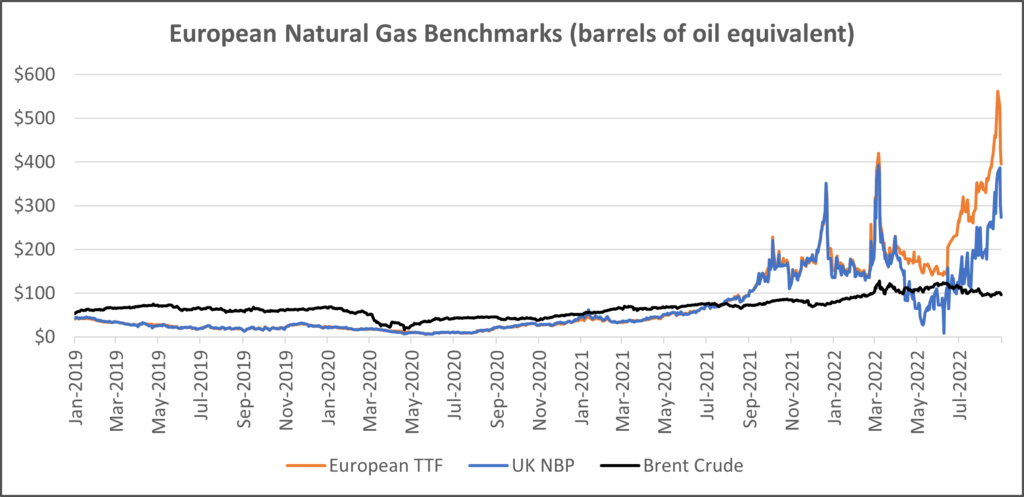
Large energy importing countries have thus far been able to source the required volumes of natural gas to refill storage. European gas storage levels have reached 80% – ahead of the 1st of November target. But it has come at a substantially higher cost. The primary European gas benchmark, TTF, is up 160% this year and nearly 18 fold since the start of 2020. The Japanese and Korean benchmark, JKM, has jumped 77% this year and more than 10-fold from 2020 levels.
Energy-intensive industrial companies in Europe are under tremendous strain from the surge in power prices, which has led to a number of facilities curtailing or halting production entirely. Nitrogen fertiliser manufacturers have been hardest hit because natural gas is both a key feedstock and a source of power for the sector. Despite significantly higher fertiliser prices due to self-sanctioning of Russian and Belarussian fertilisers, 70% of European fertiliser capacity is currently offline.
The United States is a net exporter of natural gas and its regional benchmark, Henry Hub, is trading at close to a tenth of the value of European TTF. However, the Henry Hub spot price is trading close to a 13 year high of $9.13 per million British Thermal Units (MMBtu) or $53 per oil equivalent barrel. The rise has been driven by sharp increase in LNG exports to Europe, which are expected to continue through the northern hemisphere winter. The lack of sufficient pipeline infrastructure from Russia to Asia and Europe weaning itself off Russian gas over the next year, is anticipated to result in greater linkages between regional gas benchmarks based on global rather than regional supply/demand dynamics, narrowing the current differential.
For European and British consumers, despite other sources of energy used to generate electricity, the price of natural gas is the most influential determinant of electricity prices. Due to this link and a relatively illiquid electricity trading market, the surge in natural gas benchmark prices have had a knock-on impact on the spot and one-year forward price of electricity across the continent. Last week, German year ahead electricity prices topped €1000/MWh – equivalent to just over R17/kWh (compared to Eskom’s standard tariff of less than R2/kWh).
Consumers have been partially shielded from the recent rise due to price caps by regulators. However, this has shifted the burden to utilities – several of which have needed to be bailed out by governments. In response, OFGEM, the British energy regulator, recently raised the electricity price cap from £1 971 to £3 549/year (nearly R6000 per month) from the 1st of October. This doesn’t represent the maximum household energy bill but rather what the average bill would be at the current per unit cap level. Over the last few years, the average bill has been around £1 100/year. Going forward, adjustments to the cap will be made quarterly rather than semi-annually. According to Cornwall Insight, the average energy price cap is forecast to rise to £5 387 in January 2023 and £6 616 in April 2023. In anticipation of the higher cap in January, Citibank and Goldman Sachs have warned that UK inflation could exceed 18% in January 2023.
Most European governments are likely to ease the pain on households by cutting taxes and/or offering support to lower income households. This will need to be funded by the government and not by utilities themselves, putting further strain on government finances going forward.
Europe is undoubtedly in a precarious position and there are a range of scenarios that could play out over the next four months. Although gas storage is expected to be full ahead of winter, supplies would only be sufficient to cover a maximum of 3 months of average demand. A further drop in pipeline gas deliveries from Russia remains a key threat to supply. Weather will be an important factor and given the increasingly unpredictable and extreme weather patterns being experienced across the globe, it is impossible to predict how the season will progress. One thing Europeans won’t be dreaming of this year, is a white Christmas.