Global financial markets have experienced a tumultuous six weeks. Equities, bonds, and commodities prices have fallen in unison as risks to all asset classes have risen. Cash – much maligned over the last decade’s bull market – has been king.
Russia’s war on Ukraine, despite no end in sight, has taken a backseat to additional factors that are causing a bigger dent to investor sentiment. These include the impact of intensifying COVID lockdowns implemented across much of China, together with the sharp tightening of financial conditions across the developed world.
The Russian invasion, Chinese lockdowns, and growing expectations for more aggressive tightening of monetary policy are all market moving in isolation. Experiencing all three simultaneously is a cocktail that investors are finding difficult to digest. There has been nowhere to hide and even traditional safe havens have failed to provide refuge.
Russia’s invasion caused significant disruptions to the flow of commodities around the world, leading to a spike in industrial and agricultural commodities prices. Commodities are experiencing a supply crunch due to the ostracization of Russia, leading to a surge in commodity related stocks. Growing supply shortages have been seen across oil, steel, palladium, battery-grade nickel, and coal, among others.
The supply shock has now been countered by a demand shock from China, the world’s largest commodity importer, as the country experiences its worst ever COVID outbreak. Nomura estimates that about 328 million people in over 40 cities have been affected by the latest lockdowns. The country’s “COVID zero” policy and authoritarian approach has led to the total shutdown of businesses in certain cities – most significantly in Shanghai – causing a substantial drop in economic activity and related decline in commodity demand.
Outside of commodities, China’s hard lockdowns are worsening the situation for already strained supply chains. Container ships are facing huge delays at Shanghai’s port due to a lack of dock workers and stringent COVID protocols. At its recent results presentation, Adidas noted that nearly half of its reported inventories for North America and Europe were currently in transit. As the factory of the world, the impact of delays in production and shipments from China will ripple across the world and prolong the normalisation of global supply chains.
Last week, the US Federal Reserve raised interest rates by 50 basis points (bp), as expected, following the 25bp increase in March. The level of inflation has become an increasing concern for the members of the rate setting committee (FOMC), leading to expectations of 50bp hikes at each of the next two FOMC meetings. Although most of the increase for the year, as guided for by the FED, is “priced in,” the FED has recently expressed a willingness to follow a more aggressive tightening path if needed.
The impact on oil and agricultural staples pricing from the Russia/Ukraine war and the intensification of supply chain pressure present upside risks to the inflation outlook. The longer these impacts persist, the greater the likelihood that the FED will need to increase rates in larger increments to satisfy arguably the most important of its dual mandates – price stability.
As a consequence of the inflation outlook and rising interest rates, US 10-year government bond prices have fallen around 10% this year, with the yield rising above 3% – the highest since the end of 2018 and up from 1.5% entering the year. Following a decade of low bond yields across the developed world, the speed of the rise has led to a dramatic tightening of financial conditions, notwithstanding the short-term rate set by the FED remaining below 1%.
Technology shares that have been the primary beneficiaries of the low yield, low growth era have borne the brunt of the pain. The Nasdaq Composite index is down 26% this year, having fallen 18% since the start of April. The index has erased all its gains from 2021 and is at the lowest level since November 2020.
The selling pressure has been most acute for the high growth names whose share prices soared following the market sell-off in March 2020. Most of these companies remain unprofitable and valuations had reached eye watering levels. Many of the companies that have lost over half their value this year are still growing at enviable rates. The biggest impact on share prices have come from a substantial moderation in the valuation multiples investors are willing to pay.
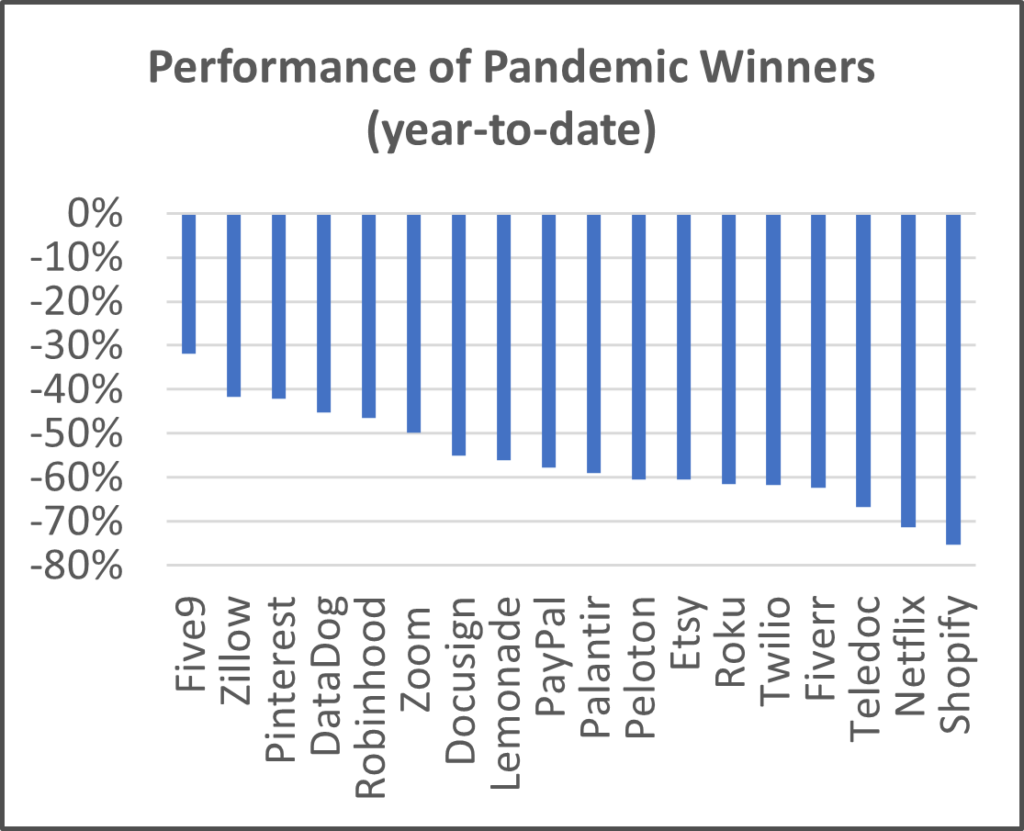
No company or exchange traded fund (ETF) encompasses the rampant speculation associated with the post-pandemic period more than Cathie Wood’s ARK Innovation ETF. The actively managed ETF focuses on companies with the potential for (very) high growth, whose value is based on the expectation of profits far into the future. Following the recent sell-off, the ETF is now down 74% from its peak. Since the launch of the ETF in 2014, investors would have been in the same position investing in an S&P 500 ETF.

The S&P 500 and MSCI World indices have experienced more moderate declines of 16% and 17% this year, respectively. The higher weighting of “value” sectors and lower exposure to unprofitable technology companies helped mitigate valuation headwinds experienced by most of the Nasdaq constituents.
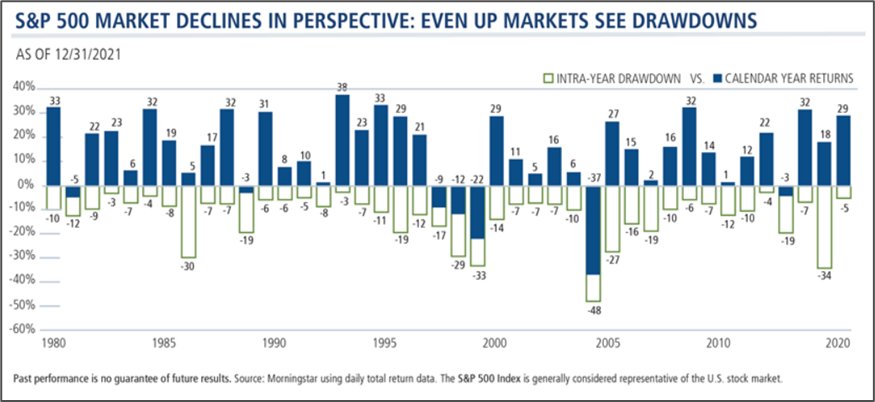
As difficult as the decline is to stomach, it is important to take a step back and put things into context. From the end of 2019, the Nasdaq, S&P 500 and MSCI World indices are up 30%, 24% and 13%, respectively. Although the recent decline has been the largest since March 2020, drawdowns of this magnitude are not uncommon. In 21 of the last 41 calendar years, the S&P 500 has experienced a double digit decline during the year.
During these years, the S&P 500 declined, on average, 13% from peak to trough.
We certainly acknowledge that 2022 will not be a typical year. Uncertainty is higher than at anytime in recent memory. However, a key difference between today and prior crises is that the problems the world faces are not of a systemic nature. Furthermore, banks around the developed world are strongly capitalised with a high proportion of quality liquid assets. Although global supply chains are only likely to normalise in 2023, Russia’s invasion of Ukraine and COVID lockdowns in China are decisions made by their respective governments. We can’t know for certain when they will end. What we do know is that you want to retain exposure to equities when they do and build long-term positions in quality companies during periods of weakness.